For clinicians managing patients with advanced illness, unplanned emergency department visits and hospital readmissions represent one of the most persistent and costly gaps in care. These events are rarely random. They follow predictable patterns: undertreated symptoms, caregiver crisis at home, medication management breakdowns, and the absence of a reachable clinical contact at 2 a.m.
Hospice is not simply an end-of-life service. When enrolled at the right time and coordinated well, it functions as a proactive clinical infrastructure that addresses the exact conditions that drive unnecessary utilization.
This post is written for physicians, hospitalists, discharge planners, care managers, and facility staff who refer patients to hospice or who are evaluating how hospice partnerships can support quality outcomes in their own practice settings.
How Hospice Addresses Each of These Drivers
A well-functioning hospice provider is not a passive service. It is an active clinical partner that intercepts the conditions driving unnecessary utilization at its source.
- 24/7 Clinical Access Replaces the ED as the First Call. The most direct mechanism hospice uses to reduce ED visits is continuous on-call nursing availability. When a patient’s pain escalates at midnight, or when a family does not know whether what they are seeing warrants emergency intervention, they call the hospice nurse. That nurse can assess the situation remotely, provide real-time clinical guidance, adjust medications within the existing care plan, and dispatch a nurse to the home when needed. In the majority of cases, this clinical touchpoint resolves the issue without an ED visit or 911 call. At Golden Rule Hospice, on-call support is available around the clock, every day of the year. Families and facility staff have a direct number to reach a clinical team member at any hour. Visit our Contact page for direct lines, or call us at (470) 395-6567 to discuss a specific patient situation.
- Proactive Symptom Management Reduces Crisis Events. Hospice nursing visits are not reactive. They are scheduled with a frequency calibrated to the patient’s acuity, and each visit includes a structured symptom assessment, medication review, and clinical update to the physician and care team. The hospice nurse identifies symptom trends early, before they become crises. Increasing dyspnea in a COPD patient is addressed at the visit level through medication adjustment and positioning education, not after an emergency room visit. Worsening pain in a cancer patient is
- Caregiver Education Reduces Panic-Driven Utilization. A significant portion of avoidable ED visits in advanced illness are initiated not by clinical need but by caregiver uncertainty. A family member who does not know whether a change in breathing is expected, who cannot reach anyone to ask, and who is frightened will call 911. The hospice care team systematically addresses this through ongoing caregiver education. Family members learn what normal disease progression looks like for their loved one’s specific diagnosis. They learn which changes to monitor, which changes to report to the hospice nurse, and which changes are part of expected decline and do not require emergency intervention. Our Family and Caregiver Support services are specifically designed to build caregiver capacity over time.
- Goals of Care Alignment Reduces Unwanted Interventions. Hospice social workers and nurses are trained to facilitate ongoing goals of care conversations with patients and families. These conversations do not happen once. They are revisited as the illness progresses and as the patient’s priorities and understanding evolve. For referring clinicians, this means that patients you refer to hospice with incomplete or conflicting goals-of-care documentation will receive dedicated attention to clarifying and documenting those preferences. This protects the patient, supports the family, and reduces the liability that comes with undocumented care preferences at the time of an acute event.
The Role of Transitional Care in Bridging the Eligibility Gap
One of the most clinically significant drivers of avoidable readmissions is the period between when a patient’s illness is clearly advancing and when they formally meet Medicare’s criteria for hospice enrollment.
This gap is real. A patient with end-stage heart failure may be experiencing frequent decompensations, have a clearly deteriorating trajectory, and be an ideal candidate for the proactive support hospice provides, but may not yet have a physician-certified six-month prognosis documented.
During this window, patients are vulnerable. Symptom crises go unmanaged. Families are without clinical support. And readmissions accumulate.
Golden Rule Hospice addresses this directly through our Transitional Care benefit, a service unique to our organization. When a patient is actively declining but has not yet crossed the clinical threshold for Medicare Continuous Care, Transitional Care provides additional clinical presence and family support to stabilize the situation and prevent unnecessary acute utilization while the eligibility picture clarifies.
What Coordinated Hospice Looks Like in Facility Settings
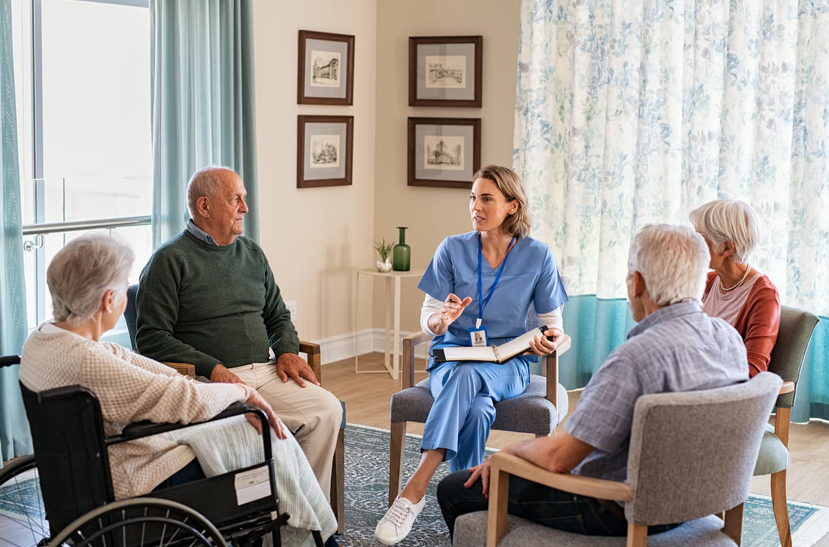
For case managers and discharge planners working with patients in skilled nursing facilities, long-term care facilities, or assisted living communities, the hospice coordination model is particularly relevant.
When hospice is enrolled for a nursing home resident, the hospice team does not replace the facility’s staff. It adds a specialized layer of comfort-focused clinical management on top of existing residential care. The hospice nurse communicates directly with the facility’s charge nurse and medical director, aligns the care plan across both teams, and serves as the primary point of contact for symptom-related concerns that might otherwise result in a facility-initiated 911 call.
Facilities that have established hospice partnerships report meaningful reductions in after-hours emergency transfers, particularly for expected end-of-life events that are mismanaged in the absence of a hospice provider.
Physical Symptom Management: What the Hospice Team Covers
For clinicians whose patients have complex symptom burdens, understanding the scope of what hospice manages directly is important for setting appropriate referral timing.
Our Physical Support and Management services include:
- Pain assessment and medication titration under physician-approved protocols
- Dyspnea management, including medication, positioning, and respiratory support
- Nausea and vomiting management
- Wound and pressure injury care
- Oral care and hygiene support for patients who cannot self-manage
- Urinary catheter care and management
- Seizure and agitation protocols for neurological diagnoses
- Skin integrity monitoring and prevention protocols for immobile patients
Medications and durable medical equipment related to the terminal diagnosis are covered under the Medicare hospice benefit and supplied directly by the hospice provider. This removes the logistical burden from the referring practice and from the family.
Partner With a Hospice Team Built for Clinical Coordination
The difference between a hospice provider that reduces readmissions and one that does not is not the benefit structure. It is the clinical infrastructure, the communication standards, and the commitment to proactive management rather than reactive response.
Our team serves patients across 18 counties in the greater Atlanta area. We are available to discuss specific patients, walk through eligibility questions, or meet with your team to establish a referral relationship. Call us directly at (470) 395-6567 or visit our Contact page. Our care team is available 24 hours a day, 7 days a week.
We live by the Golden Rule
Treat others the way you would like to be treated.